Home

About Us

General Information 

Guest Comments

Rooms & Rates

Bird List

Bird Guide

Mammals

Butterflies

Plants

Reptiles

S.E. Arizona

Winter

Maps

Reading

Links

CCR-LOGO.gif (6812 bytes)

Southeastern Arizona Information

Vista-Point2.jpg (23390 bytes)
Vista Point is two miles from Cave Creek Ranch


The Chiricahua Mountains 

Many people think that southern Arizona is a land of only harsh deserts. But the region is hardly a desert in the traditional sense of the word. In fact, this part of Arizona has a wealth of habitats, from dry deserts to tawny grasslands to lush pine forests, and many more in between.

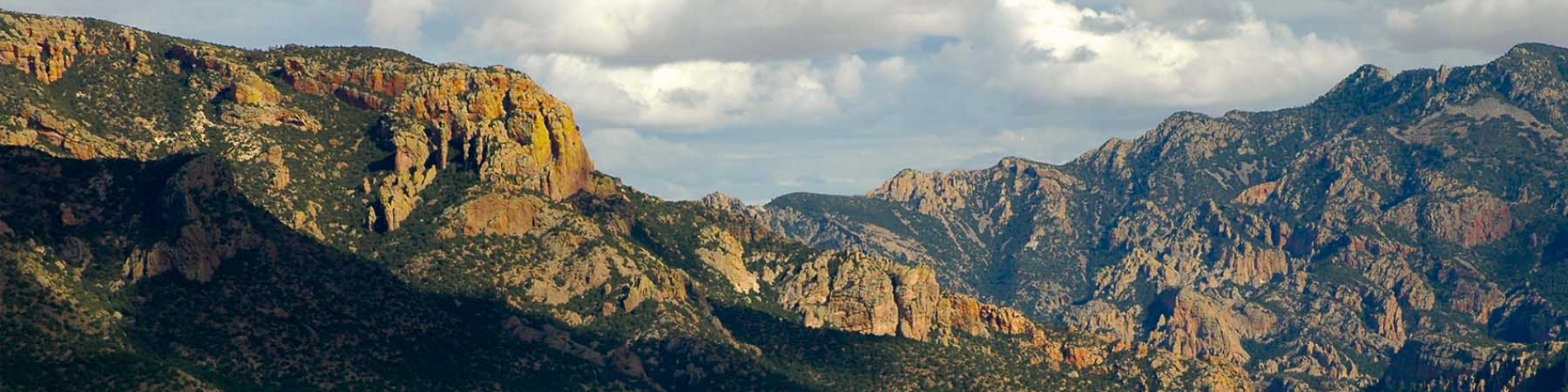
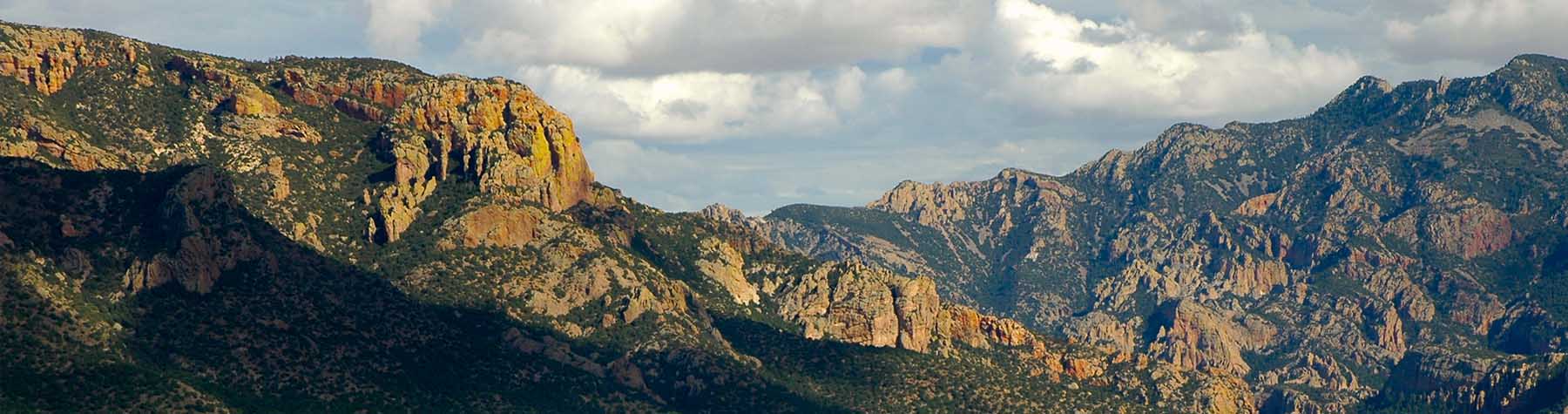
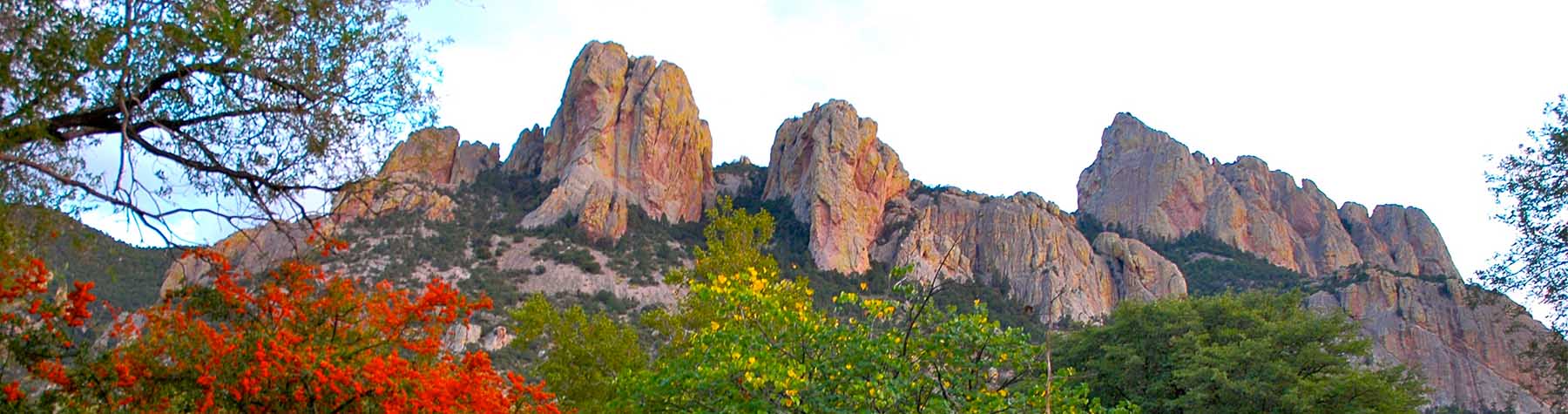
The Chiricahua Mountains of far southeastern Arizona are the single largest range in the state, rising from 3,000-foot desert and grassland plains to 9,796 feet at its highest point,cliffs.jpg (10937 bytes) Chiricahua Peak, and stretching 40 miles long by 20 miles wide. On the western side of the range the Sonoran Desert laps at the foothills; this is also the location of Chiricahua National Monument. On the eastern side of the range are vast plains of Chihuahuan desert and grassland. The range itself sits in a chain or "archipelago" of mountains that link the Rocky Mountains of the U.S. and Canada with the Sierra Madre Occidental in Mexico. Thus, the Chiricahuas are a crossroads for 4 distinct ecological regions--two deserts and two mountain chains.

The great diversity of the plants and animals of the Chiricahuas evolved because of this bio-geographical mix, and because of distinct regional climate patterns. True desert communities exist from roughly sea level to about 4,000 feet, but on the mountains, for every 1,000 feet gained in elevation, the average temperature drops about four degrees, and rainfall increases about four inches. So while the deserts around the Chiricahuas are baking at 100ºF on a dry June midday, the mountain peaks are a comfortable and damp 75ºF, thus allowing species to thrive that would die if you plucked the hapless creatures off the mountains and deposited them in the desert. The elevational break in heat and additional moisture are thelucifer55.jpg (20804 bytes) keys to life for the plants and animals that are surviving in the Sonoran and Chihuahuan Desert regions on mountain ranges surrounded by seas of desert and grassland. This is the origin of the romantic term "sky islands" now in popular use to describe the 42 or so such ranges in the deserts of southern Arizona and northern Mexico. Other well-known sky islands include the Huachuca Mountains (home of Ramsey Canyon), the Santa Rita Mountains (home of Madera Canyon), the Catalina Mountains, and the Baboquivari Mountains (home of Brown Canyon).

EXPLORING

Pinery Canyon Road traverses the Chiricahuas, beginning at Chiricahua National Monument and ending at Portal. It is 22 miles long, but narrow, dirt, and winding--so plan at least an hour and a half drive and loads of scenery (it is closed in winter due to snow). There is also a scenic dirt road drive from Portal to Paradise, looping back through Cave Creek Canyon. And on the southern end of the range, Turkey Creek Road traverses the foothills there, past Rucker Lake, which is dry right now.

There are over 100 miles of hiking trails in the Chiricahuas, ranging from the easy walks around Cave Creek Ranch and the Coronado National Forest visitor center, to strenuous climbs in Green House Basin, and through-hikes on the Crest Trail.


Nearby Petroglyphs

During spring and summer, Coronado National Forest operates an excellent visitor center just 2/10ths of a mile up the canyon from Cave Creek Ranch. Free information and excellent natural history displays are available.

Numerous scenic drives surround the Chiricahuas. Our staff at Cave Creek Ranch will be happy to advise you on all the possibilities.

See our "Suggested Reading" page for recommended books on exploring the region.

CLIMATE

Arizona experiences a bi-seasonal weather regime comprising two seasons of rain and two of drought. To further clarify important life cycles for southern Arizona desert plants and animals, some naturalists have taken to adding another season to our year, creating a year that starts with spring (February, March and April), moves into a severe fore-summer drought (May and June), then summer and our period of greatest rain (July, August and the first half of September), followed by fall and our second and less severe time of drought (late September through November), and finally winter and our second period of rain (December and January).

Summer rains, normally a little over half our total annual rainfall and locally dubbed "monsoons," come from the south. In early summer, the end of June through the middle of August, the storms typically come from the Tropical Atlantic air mass, pulling moisture from the Atlantic Ocean and Gulf of Mexico. These storms are primarily small-less than three miles in diameter-intense and convectional in nature, the result of moist tropical air moving over strongly heated and mountainous terrain in northern Mexico and southern Arizona. When it hits the highlands, the air mass rises rapidly, cools and condenses. This is what creates our spectacular thunderheads that tower 20,000 feet into the atmosphere. Usually these rains begin with a bang in late June or July, cutting the intense dry heat of May and June as surely as a knife. The relief to all life-forms is apparent as plants burst forth with new leaves, desiccated amphibians come out of their temporary dry tombs to mate, and humans adopt more pleasant moods.

In late summer, the end of August through September, the storms often come from the Tropical Pacific air mass, drawing their moisture from the Pacific Ocean and Gulf of California. These storms are usually larger than those of Atlantic origin, and may be fringes of Mexican west coast hurricanes.

October through November are usually dry, though on rare occasion we will have unusually wet periods, characterized by days on end of gentle rain. This is the result of El Niño, a phenomenon affecting world weather patterns that occurs when warm Pacific Ocean currents off South America move farther north than normal, sending out-of-season tropical storms up north. When this happens for days or weeks at a time, as it did here in 1983, spectacular flooding causing millions of dollars of damage can result.

In winter, a second, less intense season of rain occurs. Westerlies bring Polar Pacific air moisture onto the continent through Washington and Oregon, and occasionally central California. Depending on the location of the Jet Stream, these storms may pass into Arizona. Because thermal heating is much less intense in the winter, upslope air movement is slow, the clouds are widespread and the rain is gentle and covers broad areas. But winter rains are much less dependable than summer rains; it is not uncommon for our area to receive negligible winter precipitation. It is our winter rains, los equipatos to the native old-timers, that determine the successful germination of spring annual wildflowers.


TEMPERATURES & RAINFALL
AT CAVE CREEK RANCH

April through May expect cool nights and early mornings (60s) and warm to hot afternoons (mid-80s to 90s). This period is usually dry.

June and early July, expect nights in the high 60s or low 70s and hot days, in the 90s. Summer rains may start in mid-July.

July through mid-September is the "monsoon" season, with mornings in the high 60s and days as high as the 90s but dropping with sometimes daily thunderstorms (can drop to the 70s).

October through December is dry, and temperatures drop to the 30s to 50s at night and rise to the 60s to 70s in the days; however, sometimes summer temperatures will extend into October.

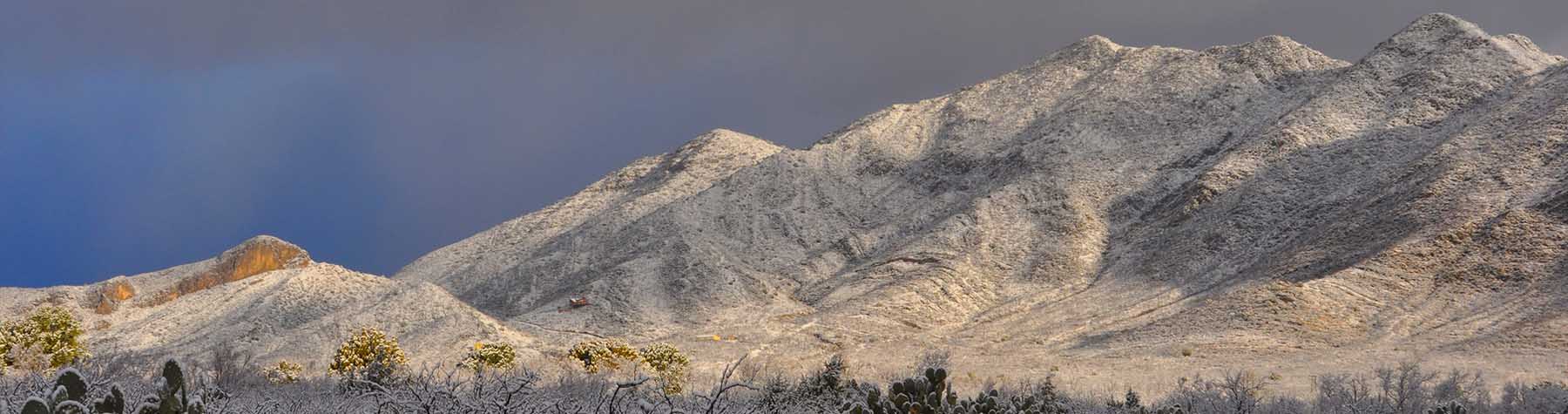
January through March is "winter" for us, with lows dropping to or below freezing, and highs in the 50s or 60s, sometimes the 40s. It snows in the high country, rains at lower elevations.

  • Best birding months: late April and May; late July and August (migrations). The birding is also excellent in the winter.
  • Best wildflower months: April and August-September
  • Best butterfly months: August and September
  • Best reptile months: July through September

Just a few miles up the road:  Visit the American Museum of Natural History's Southwest Research Station 

Cave Creek Ranch
P.O. Box 16554
Portal, AZ 85632
tel 520-558-2334
fax 520-558-2313

E-mail:
info@cavecreekranch.com


Home | Rates | Bird List | Mammals | Butterflies | Plants | Reptiles | S.E. Arizona | Contacts | Maps | Reading | Links

Website Design & Maintenance by Hummingbird World


Current Weather:
Click for Douglas, Arizona Forecast

Note: We are usually a little cooler than Douglas.